When customers receive a new garment, the fabric may look smooth and clean.
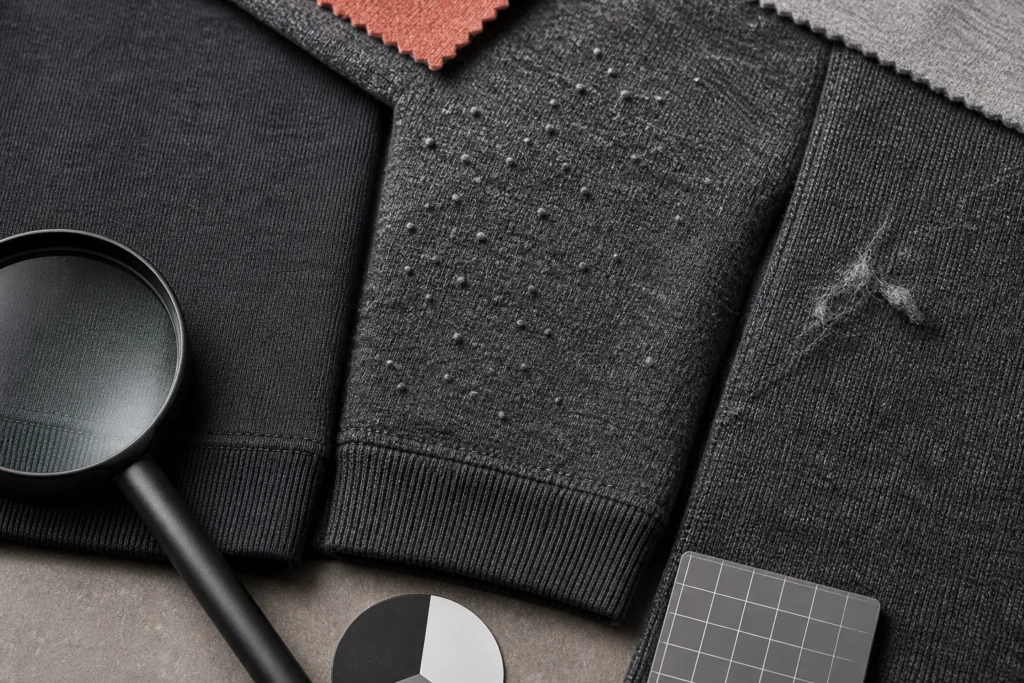
After repeated wearing, however, small fiber balls can begin to appear on the surface.
This phenomenon is known as pilling.
For uniforms, teamwear, hoodies, training clothing, and frequently washed garments, pilling can influence the perceived quality of the product.
What Causes Pilling?
Pilling occurs when loose fibers migrate toward the surface of a textile and become tangled through repeated friction.
The result is a collection of small fiber balls attached to the fabric surface.
However, not every damaged-looking fabric surface represents pilling.
A recent 2026 buyer guide from Jiashun Clothing distinguishes pilling from other surface changes such as fuzzing, matting, snagging, and abrasion.
This distinction matters because different problems can have different causes.
Pilling vs. Abrasion
Pilling involves fibers forming small balls on the surface.
Abrasion is the physical wearing away of the textile caused by repeated rubbing.
A garment can therefore have:
- significant pilling
- surface fuzzing
- actual thinning from abrasion
These are not necessarily the same problem.
Where Is Pilling Common?
Pilling is often associated with areas that experience repeated friction.
Examples include:
- underarms
- sides of the torso
- elbows
- inner thighs
- areas under bags
- seat areas
- cuffs
The actual locations depend on how the garment is worn.
A uniform worn every day may experience different friction patterns from a promotional T-shirt worn occasionally.
Why Fiber Type Matters
Different fibers and yarn constructions can behave differently under friction.
Fiber length, yarn structure, fabric construction, finishing, and blending can all influence surface behavior.
This is why simply specifying:
“Use anti-pilling fabric.”
may not provide enough information for a manufacturer.
A buyer needs a measurable requirement.
What Is a Pilling Test?
A pilling test exposes a textile to controlled rubbing or mechanical action and then evaluates the resulting surface appearance.
A proper test specification may include:
- test method
- specimen preparation
- exposure or cycle level
- conditioning
- evaluation procedure
- rating system
- acceptance level
A recent 2026 buyer guide emphasizes that a pilling requirement becomes much more useful when these details are defined rather than simply requesting an “anti-pill” fabric.
Why Visual Inspection Alone Is Not Enough
A new sample may look perfect.
But a visual inspection of a new garment cannot tell you exactly how the fabric will behave after months of repeated use.
For long-term programs, buyers may therefore want performance information in addition to appearance inspection.
This is particularly useful for:
- school uniforms
- workwear
- teamwear
- hospitality uniforms
- frequently washed staff clothing
Pilling and Custom Team Apparel
Team apparel can experience repeated washing and frequent use.
For example, a training shirt may be worn several times per week.
A hoodie may rub against sports equipment or backpacks.
A team jacket may be worn throughout an entire season.
In these situations, durability becomes part of the product specification.
What Buyers Should Ask
Before approving a fabric, buyers can ask:
- Is pilling performance specified?
- Which test method is being used?
- What rating is considered acceptable?
- Is the test performed on the actual fabric?
- Has the fabric been tested after finishing?
- Are high-friction areas considered?
- Are test results available for approval?
These questions help turn a vague quality expectation into something measurable.
Fabric Performance Should Match the Product
Not every garment needs the same level of abrasion resistance.
A promotional T-shirt intended for occasional events has different requirements from a uniform worn five days a week.
Similarly, premium fashion-oriented apparel may prioritize surface appearance while industrial workwear may prioritize durability.
Therefore, the appropriate requirement should be determined by the garment’s intended use.
Our Approach to Fabric Performance
For custom apparel development, fabric selection can be combined with performance requirements from the beginning.
Rather than treating pilling as a problem discovered after production, buyers and manufacturers can define the expected performance before bulk manufacturing.
This gives both sides a clearer quality target.
Final Thoughts
Pilling is a small technical issue that can have a major impact on how customers perceive garment quality.
The key is to distinguish pilling from other types of surface damage and define durability requirements using measurable testing criteria.
For B2B buyers, a clear performance specification is much more useful than simply asking for a fabric described as “high quality” or “anti-pilling.”