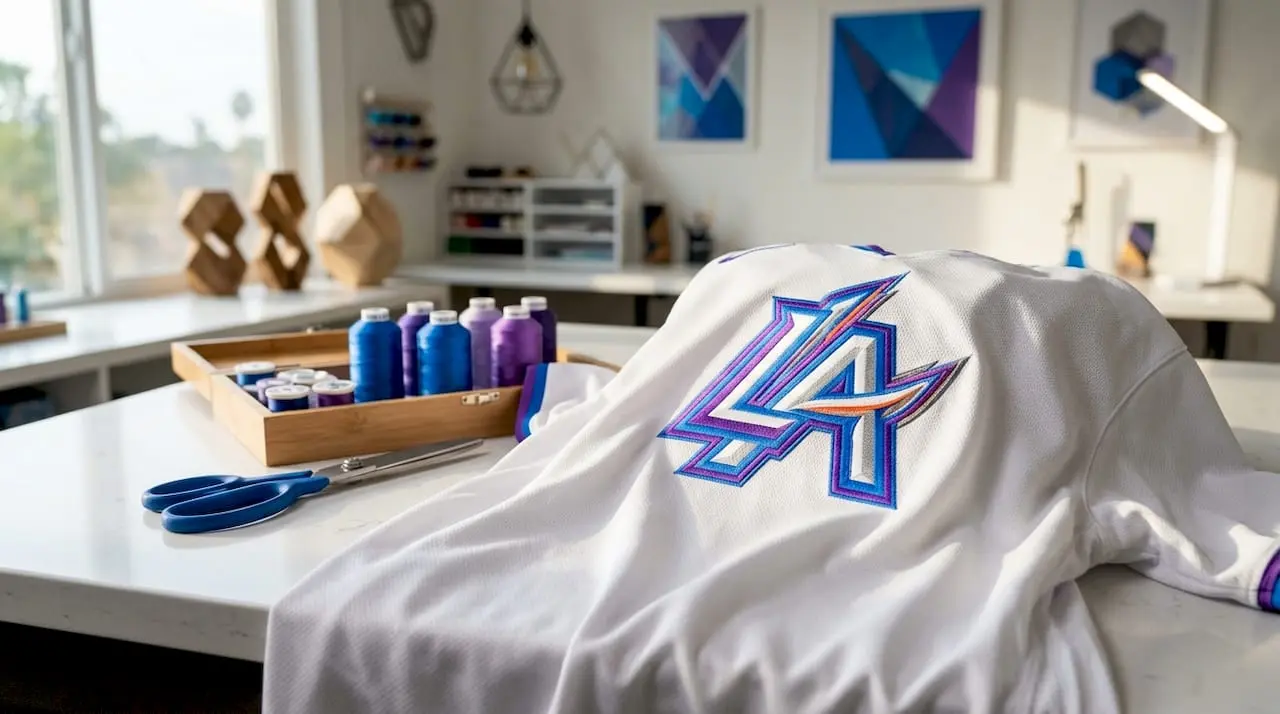
A custom team uniform may contain several different visual elements:
- team logo
- sponsor logo
- player name
- player number
- event logo
- manufacturer branding
The challenge is not simply fitting all of these elements onto a garment.
They need to be arranged so that the final uniform remains readable, balanced, and functional.
Start With a Visual Hierarchy
Not every graphic should have the same level of prominence.
A team logo may represent the primary identity.
A sponsor may require a specific position.
A player number needs to remain readable from a distance.
A smaller event logo may play a secondary role.
Before production, buyers should therefore decide:
What should people notice first?
Then the layout can be designed around that hierarchy.
Common Logo Positions
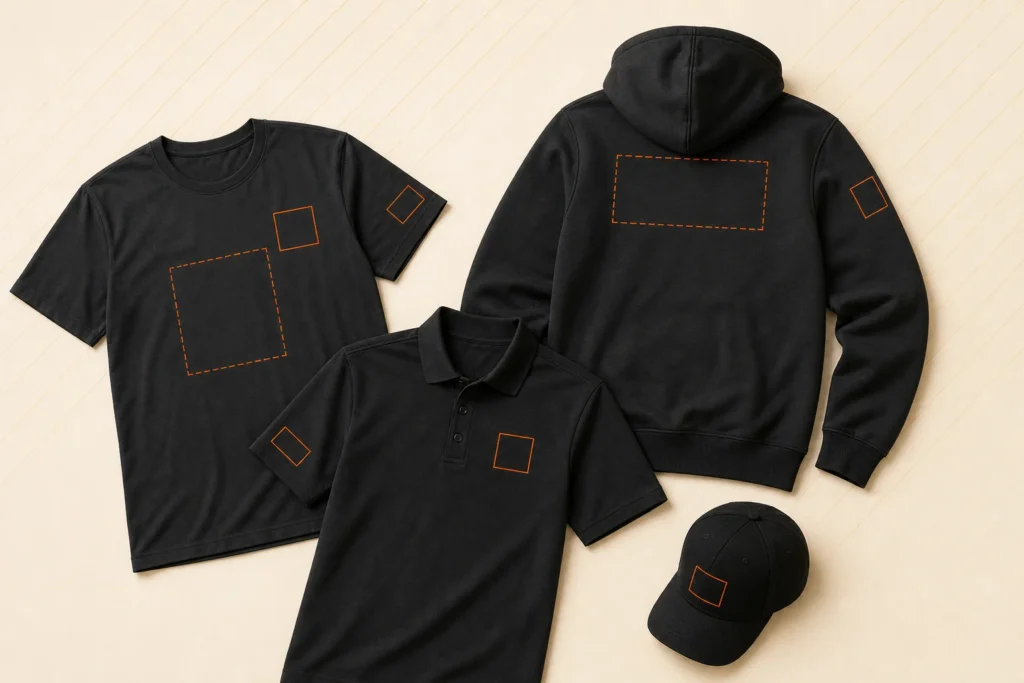
Typical locations include:
- left chest
- center chest
- upper back
- sleeve
- lower front
- shorts
- trouser leg
Recent 2026 apparel placement guides identify left chest, center chest, back, sleeve, and other locations as common options, while emphasizing that final placement should account for the garment, artwork, and decoration method.
Player Names and Numbers
Team jerseys have additional requirements.
The back commonly contains:
Player Name
above
Player Number
The number needs enough visual space to remain readable from a distance.
Its position should also avoid:
- seams
- vents
- pockets
- zippers
- curved construction areas
This is one reason the garment pattern and customization layout should be considered together.
Sponsor Placement
Sponsors may have specific contractual requirements.
A sponsor agreement might specify:
- location
- minimum size
- maximum size
- orientation
- number of appearances
- garment types
These details should be converted into production specifications before manufacturing.
A 2026 team-branding guide also highlights the importance of defining placement precisely rather than relying on vague descriptions such as “prominent placement.”
Why Different Garments Need Different Layouts
A logo position that works perfectly on a T-shirt may not work on a jacket.
A jacket may have:
- zipper
- pockets
- seams
- hood
- collar
A hoodie may have:
- kangaroo pocket
- drawcord
- hood
- ribbed cuffs
A polo may have:
- button placket
- collar
- chest pocket
Therefore, a team branding system should not simply copy the exact coordinates from one garment to another.
Instead, the visual relationship should remain consistent.
Logo Size Is Not Universal
A common mistake is specifying:
“The logo should always be 4 inches wide.”
That may work for one garment but look too large on a smaller size.
A narrow logo and a wide logo may also require different treatment.
The actual size should therefore be checked on the garment and size range.
Affinity Creative’s 2026 placement guide recommends confirming final scale using a proof on the actual garment rather than relying entirely on generic dimensions.
Decoration Method Can Affect Placement
Different customization methods have different practical requirements.
For example:
- embroidery needs sufficient space and stable fabric
- printed graphics may accommodate more detailed artwork
- large graphics need sufficient flat surface
- certain garment seams can make decoration difficult
Therefore:
Artwork + garment construction + decoration method + placement
should be considered as one system.
Create a Placement Standard
For organizations ordering teamwear repeatedly, it is useful to establish a simple placement standard.
For example:
Primary logo: left chest
Player name: upper back
Player number: center back
Sponsor: sleeve
Shorts logo: lower front
The exact locations can then be documented in a visual reference.
This makes future reorders easier.
Our Approach to Team Apparel Customization
For custom teamwear projects, our production team can review logo, name, number, and sponsor placement together with the garment design.
The goal is to ensure that customization works with the garment rather than being added after the garment design has already been finalized.
This can help maintain consistency across jerseys, shorts, jackets, hoodies, and other team apparel.
Final Thoughts
Good team apparel design is not simply about adding more logos.
It is about creating a clear visual hierarchy and making sure every customized element has an appropriate location.
When logo, name, number, sponsor, garment construction, and decoration method are planned together, the final product is easier to manufacture and more consistent across the entire team.