

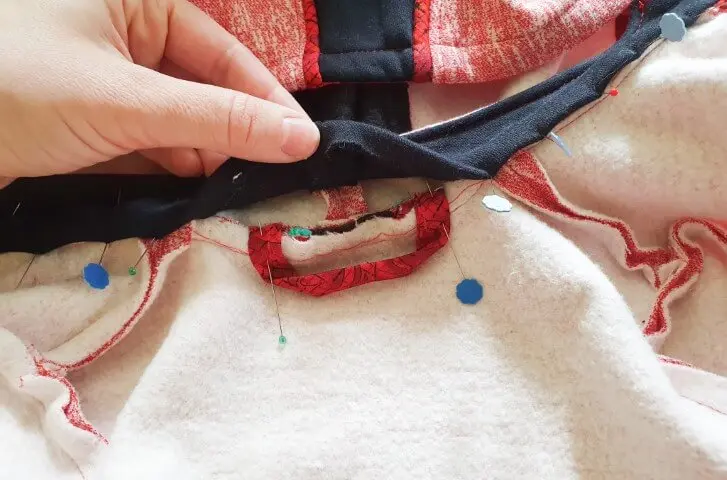
A hanging loop is a small fabric or tape detail attached inside a garment to make it easier to hang on a hook. It is commonly found in jackets, coats, shirts, uniforms, and some workwear.
Although it is not always visible during normal wear, a poorly designed hanging loop can tear away, distort the garment, or create discomfort around the neckline.
For custom apparel suppliers, this detail deserves attention during garment construction.
1. Select a Suitable Location
The most common location for a hanging loop is inside the back neckline.
This position allows the garment to hang relatively evenly when placed on a hook. It is especially useful for jackets, coats, and uniforms that need to be hung between uses.
However, the correct position depends on the garment structure.
For lightweight shirts, the loop should not interfere with the neck seam or create unnecessary pressure against the wearer’s neck.
For heavier outerwear, the attachment point should be positioned where the garment can support its own weight without distorting the neckline.
2. Choose the Right Loop Material
Hanging loops can be made from self-fabric, woven tape, or other suitable textile materials.
The choice should reflect the garment’s weight and construction.
Self-fabric can provide a coordinated appearance because it matches the main garment. Woven tape may offer a more stable and compact alternative, particularly when the main fabric is bulky or difficult to fold neatly.
Important considerations include:
- Material strength
- Width and thickness
- Flexibility
- Color compatibility
- Resistance to fraying
- Compatibility with garment care requirements
The selected material should be strong enough for the garment while remaining comfortable and unobtrusive.
3. Determine the Correct Loop Dimensions
A hanging loop needs enough internal space to fit over the intended hook.
If it is too small, the garment may be difficult to hang. If it is excessively long, it may become visible around the neckline or hang outside the garment.
The width should also be appropriate for the garment’s weight.
A narrow loop may be suitable for a lightweight shirt, while a heavier jacket may benefit from a wider construction that distributes the load more effectively.
The final dimensions should be evaluated on the finished garment rather than only on the loose loop material.
4. Reinforce the Attachment Points
The attachment points are the most important construction areas.
A hanging loop transfers the garment’s weight to a relatively small section of fabric. If the stitching is weak, the loop may pull away during use.
Possible construction methods include securing both ends within the neckline seam or using additional reinforcement stitching.
For heavier garments, the attachment should be evaluated together with the neckline structure and facing.
The reinforcement must be strong enough to hold the garment without creating excessive thickness or visible distortion.
5. Prevent Neckline Distortion
A hanging loop should not change the shape of the garment.
If the loop is too thick or its attachment is poorly positioned, the neckline may develop unwanted bulk or become uneven.
This is particularly important for lightweight shirts, soft fabrics, and garments with narrow neck finishes.
Suppliers should inspect the neckline from both the inside and outside to ensure that the loop is securely attached and does not interfere with the garment’s intended shape.
6. Test the Loop With the Finished Garment
The loop should be tested using the actual garment rather than evaluated separately.
Check whether:
- The loop fits comfortably over a suitable hook.
- The attachment points remain secure.
- The garment hangs in a balanced position.
- The neckline does not stretch or distort.
- The loop remains inside the garment during normal wear.
Heavier garments should receive particular attention because their weight places greater demands on the attachment area.

Conclusion
A hanging loop is a small but useful garment feature. Correct placement, suitable materials, appropriate dimensions, and secure attachment help suppliers improve garment convenience without compromising the finished appearance or construction quality.

