

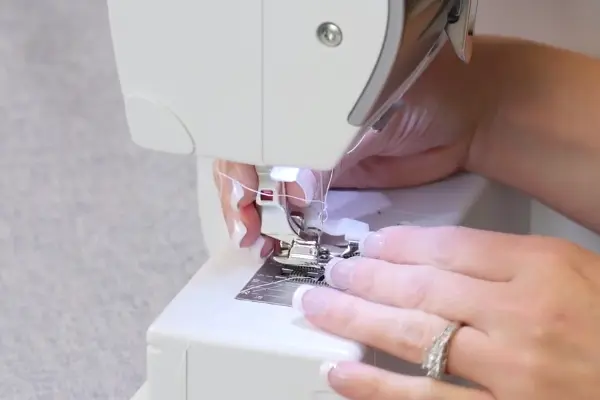
Belt loops may appear to be small details, but they influence how custom trousers function and look. Poorly positioned loops can cause a belt to shift, while weak attachment points may become damaged through repeated pulling.
For corporate trousers, uniforms, workwear, and casual custom pants, belt loop design should be considered as part of the overall waistband construction.
1. Match Belt Loop Width to the Intended Belt
The width of a belt loop determines which belts can pass through it comfortably.
A narrow loop may restrict the use of wider belts, while an excessively wide loop can allow the belt to move around unnecessarily.
Suppliers should consider the intended garment style and belt type before determining loop dimensions.
For example, formal trousers may require relatively discreet loops, while workwear may need wider loops to accommodate heavier belts.
The finished internal width should be checked after folding and stitching, rather than relying only on the dimensions of the unfolded fabric strip.
2. Determine the Number and Position of Loops
The number of belt loops should correspond to the waistband design and garment size.
Loops are commonly positioned around the front, sides, and back of trousers. Their placement should help distribute belt tension and prevent large sections of the waistband from becoming unsupported.
Particular attention should be given to the front and back positions, where loops should align with the garment’s center and overall construction.
For larger sizes, the waistband may require a different loop arrangement to maintain balanced spacing.
3. Reinforce Both Attachment Ends
Belt loops experience repeated tension when the wearer pulls a belt through them or adjusts the waistband.
Both ends should therefore be secured firmly to the garment.
Common attachment methods include reinforced stitching and bartacks. The chosen method should be compatible with the fabric weight and the overall appearance of the trousers.
The reinforcement should secure the loop without creating excessive bulk or damaging the waistband fabric.
For heavy workwear, the attachment method may need to withstand greater pulling forces than that used for lightweight casual trousers.
4. Choose Compatible Loop Fabric
Belt loops should be made from material that works well with the main garment fabric.
Using a fabric that is too lightweight may cause loops to stretch or lose their shape. A material that is too thick can create bulky attachment points.
Suppliers should consider:
- Fabric weight and thickness
- Resistance to stretching
- Color compatibility
- Washing and care requirements
- Surface texture and appearance
The loop fabric should also maintain a consistent appearance with the waistband after repeated use and laundering.
5. Check Loop Length and Finished Shape
Belt loops should provide enough room for the intended belt without standing too far away from the waistband.
If loops are too short, inserting a belt may become difficult. If they are too long, they may lift away from the garment and create an untidy appearance.
The finished loops should be straight, consistent in width, and securely attached at both ends.
For paired or symmetrical placements, the loops should also be visually balanced.
6. Evaluate Belt Compatibility and Daily Use
A useful inspection method is to test the finished trousers with a belt of the intended width.
Check whether the belt can pass through every loop smoothly, whether it remains in position, and whether the waistband stays flat.
The garment should also be checked during sitting, bending, and walking. These movements can reveal twisting, pulling, or uncomfortable pressure around the waistband.
Conclusion
Belt loops contribute to both the function and appearance of custom trousers. By controlling their dimensions, spacing, fabric compatibility, and attachment strength, suppliers can produce waist details that are practical, balanced, and durable.

