Introduction
A finished garment begins as separate pieces of fabric.
Before those pieces become a shirt, jacket, uniform, or pair of sports shorts, they need to be organized so that the correct components reach the correct production operations.
One traditional approach is the bundle system.
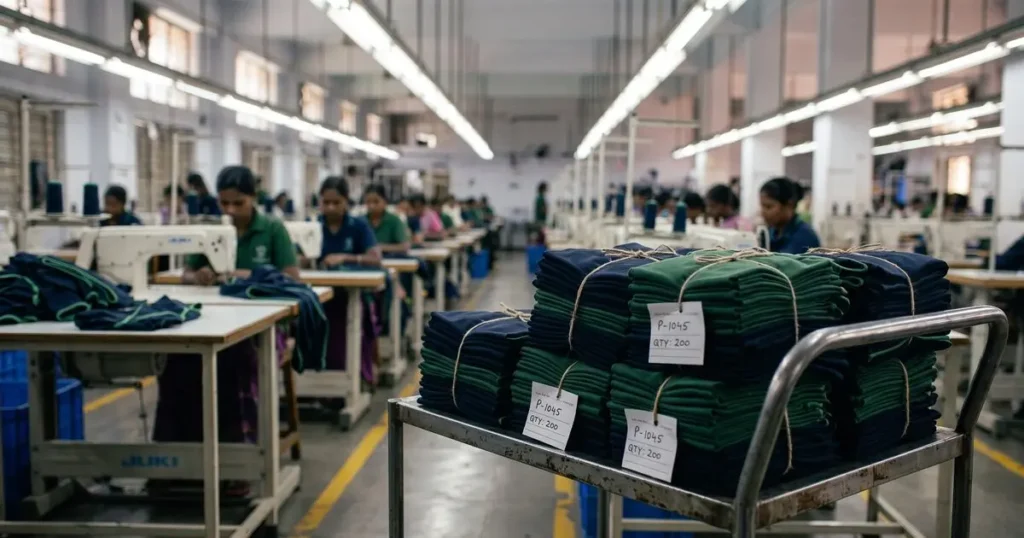
Under this system, cut garment components are grouped together into bundles according to the production requirements.
The concept may sound simple, but it plays an important role in material flow through many garment factories.
Academic literature on garment manufacturing identifies the bundle system and progressive bundle system as established apparel production methods.
1. What Is a Garment Bundle?
A garment bundle is a group of cut components that belong to a particular production unit.
Depending on the factory and product, a bundle may be associated with information such as:
- Style
- Color
- Size
- Quantity
- Production order
- Cutting batch
- Operation information
The purpose is to keep related components together as they move through production.
For example, components for one garment may include:
- Front panels
- Back panels
- Sleeves
- Collar
- Cuffs
- Pockets
These pieces must remain properly identified and organized throughout the production process.
2. Why Bundling Is Necessary
Imagine a factory cutting 5,000 garments in several colors and sizes.
Without an organization system, there is a significant risk of components becoming mixed.
A production system needs to answer:
Which pieces belong together?
Which order do they belong to?
Which size and color are they?
Where should they go next?
Bundling provides a practical method for organizing this information.
3. What Happens After Cutting?
A simplified workflow can look like this:
Fabric → Cutting → Sorting → Bundling → Sewing → Finishing → Inspection → Packing
After cutting, components are matched and organized.
The bundles can then move to the relevant sewing operations.
The exact process varies between factories and production systems, but the basic principle is maintaining the relationship between cut components and the production order.
4. Bundle Identification Is Important
A bundle needs to be identifiable.
Traditional factories may use paper tickets or other physical identification methods.
Modern factories may supplement this with:
- Barcodes
- QR codes
- Digital production systems
- Scanning stations
- Electronic production records
The technology may change, but the underlying purpose remains the same:
Keep production information connected to the physical garment components.
Recent production-tracking systems have explored QR-based bundle identification and scanning to improve visibility of style, lot, color, size, and quantity information.
5. Bundles and Work-in-Progress
One potential problem with traditional bundle-based production is that large groups of cut components may wait between operations.
This creates work-in-progress, or WIP.
For example:
Cutting → Bundle Waiting → Sewing Operation A → Waiting → Sewing Operation B
The garments are not finished, but resources have already been used.
Excessive WIP can therefore hide production problems.
Research on garment production systems has noted the relationship between bundle-based production, WIP, material movement, and throughput time.
6. Bundling Errors Can Become Production Errors
If components are incorrectly grouped, several problems can occur.
For example:
- Wrong size
- Wrong color
- Missing components
- Mixed production orders
- Incorrect panel combinations
The problem may not become obvious until sewing begins.
That is why sorting and identification are important parts of the cutting-to-sewing transition.
7. What Buyers Should Understand
International buyers do not normally need to specify exactly how a factory bundles cut components.
However, it is useful to understand the process when discussing production controls.
A buyer can ask:
- How are cut components identified?
- How are sizes separated?
- How are colors separated?
- How are bundles tracked?
- How does the factory prevent mixing?
- What happens if a component is missing?
- Is production information recorded digitally?
These questions can reveal how organized the production process is.
8. Traditional Bundles and Digital Tracking Can Coexist
Digitalization does not necessarily mean completely eliminating physical bundles.
A factory can still use physical bundles while adding digital tracking.
For example:
Physical Bundle + Barcode/QR Code + Production Scan
This can provide a connection between the physical components and production information.
Such systems may be especially useful for factories handling:
- Multiple styles
- Multiple colors
- Large quantities
- Complex production schedules
- Repeat orders
Our Approach to Custom Apparel
For custom apparel production, our approach is to keep product information connected with the physical production process.
The relevant style, material, color, size, quantity, and production requirements should remain clear as components move from cutting into sewing and later production stages.
Whether the factory uses traditional identification or digital tracking, the objective is the same: reduce confusion and maintain production consistency.
Conclusion
The bundle system may not be visible when customers purchase a finished garment, but it represents an important part of how many apparel factories organize production.
For buyers, understanding the system helps explain how thousands of individual fabric pieces can move through a complex sewing operation without becoming completely mixed together.
The most important principle is simple:
Every cut component needs to remain connected to the correct garment, order, size, color, and production process.