
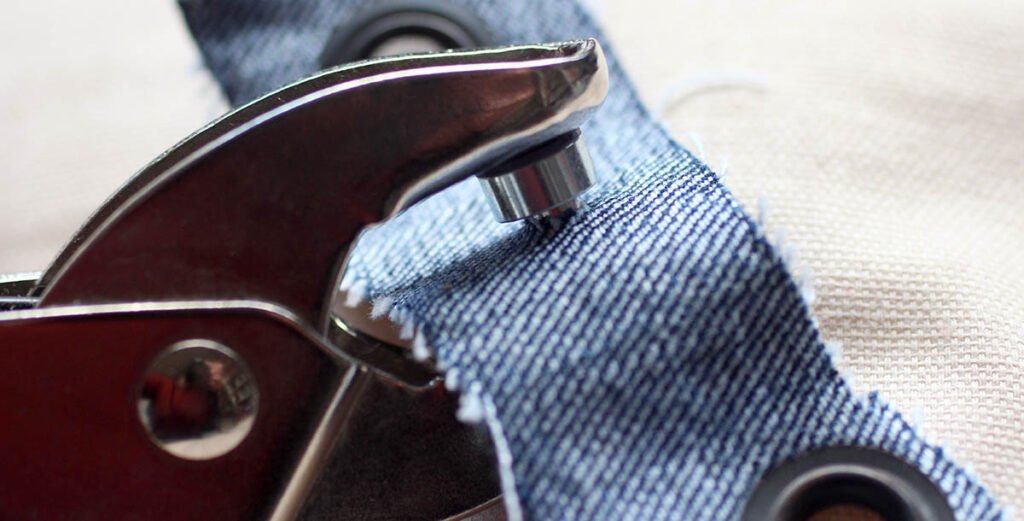
Eyelets and grommets are small details commonly found on hoodies, jackets, sportswear, and other garments that use cords or decorative openings. They can create a clean finish, but an unsuitable component or weak fabric support may cause the opening to distort or the hardware to loosen during use.
For custom apparel buyers, the goal is to confirm how the detail should look, how it will be attached, and whether the finished construction suits the garment’s fabric.
1. Specify the Type, Size, and Finish
Start by defining whether the design requires metal grommets, plastic eyelets, or stitched eyelets. These options differ in appearance, construction, and suitability for different garments.
For metal or plastic hardware, confirm the required diameter, shape, color, surface finish, and whether a backing washer is needed. Words such as “silver” or “black” may be insufficient when the buyer needs a particular visual effect.
A reference image or physical component sample can help avoid differences in interpretation. Where appearance is important, approve the actual hardware rather than relying only on a digital rendering.
2. Check Compatibility with the Fabric
The fabric’s thickness, stretch, weight, and construction affect how an eyelet behaves after installation. A component that works well on a heavy hoodie may not be appropriate for a lightweight knit.
The surrounding fabric may require an additional layer or suitable interfacing to support the hardware. However, reinforcement should be selected and tested for the actual material combination; adding stiffness without evaluation may create an unwanted feel or visible distortion.
Ask the supplier to test the proposed construction on the same fabric and reinforcement layers planned for production.
3. Confirm Position and Spacing
Specify the location of every eyelet using a clear reference point, such as the garment centerline, edge, seam, or finished opening. For paired eyelets, define the distance between them and check that the arrangement is symmetrical.
For hoodies and drawstring garments, the eyelets should align with the intended cord path. If the garment includes a lining or facing, confirm how the hardware will sit relative to those layers.
A marked sample or technical drawing is more reliable than a general instruction such as “place near the neckline.”
4. Test Attachment and Fabric Distortion
Before approving bulk production, inspect a sample for:
- Loose, spinning, or poorly seated hardware
- Cracked or damaged fabric around the opening
- Uneven spacing or alignment
- Wrinkling or puckering around the eyelet
- Sharp edges or uncomfortable contact with the wearer
- Changes after the garment is handled or washed as intended
The appropriate durability tests depend on the garment’s intended use. For workwear or sportswear that experiences repeated pulling, buyers should discuss a suitable pull or use test with the supplier rather than relying on visual inspection alone.
5. Confirm Repeatability in Bulk Production
If the design uses multiple eyelets, confirm that the size, finish, placement, and attachment method will remain consistent across all garments. A single approved sample does not automatically guarantee consistent results at scale.
Include the eyelet specification in the approved product file and define how substitutions must be authorized. If the original hardware becomes unavailable, the supplier should not replace it with a different size or finish without approval.
Our Approach to Custom Apparel
Eyelets should be treated as a functional construction detail, not simply a decorative accessory. Buyers should approve the component, fabric support, position, and finished appearance together.
For projects with frequent cord movement or heavier use, testing the complete garment construction is especially important. A small trial can reveal problems before they affect a large production run.
Conclusion
Well-specified eyelets and grommets help custom garments look consistent and function as intended. Confirming the hardware, fabric compatibility, reinforcement, placement, and attachment quality before bulk production can reduce avoidable defects and rework.