Introduction
Traditional custom apparel development often requires multiple physical samples.
A buyer may need to review:
- Garment proportions
- Colors
- Graphics
- Panel design
- Logo placement
- Styling
- Fit direction
Some of these decisions can now be reviewed digitally through 3D garment simulation.
But this does not mean physical samples are no longer necessary.
The more useful question for buyers is:
Which development decisions can be made digitally, and which still require a real garment?
1. What 3D Virtual Sampling Does
3D apparel systems can create a digital representation of a garment based on garment patterns, materials, colors, graphics, and other product information.
This allows teams to review concepts without immediately manufacturing another physical sample.
Potential applications include:
- Silhouette review
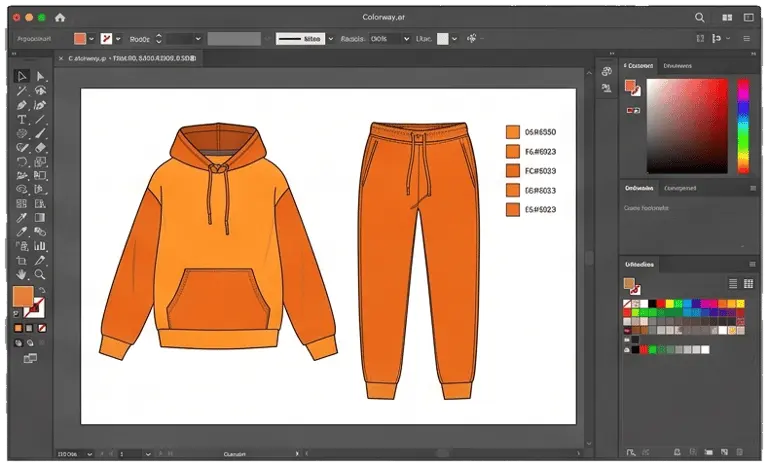
- Colorway review
- Graphic placement
- Logo placement
- Design comparison
- Internal approval
- Client presentations
- Early fit-direction review
CLO-SET describes 3D workflows as useful for design reviews and reducing some physical sampling activity.
2. 3D Is Most Useful at the Early Development Stage
Not every sample round has the same purpose.
Some early samples exist primarily to answer:
Does this design look right?
Others answer:
Does this actual garment fit and perform correctly?
3D is particularly useful for the first question.
For example, a buyer developing a team jacket may want to compare:
- Black vs. navy
- Different panel arrangements
- Logo positions
- Sleeve graphics
- Collar shapes
- Different color combinations
These decisions may be reviewed digitally before physical samples are produced.
3. It Can Reduce Unnecessary Sample Rounds
Physical samples require:
- Fabric
- Trims
- Cutting
- Sewing
- Finishing
- Shipping
- Review time
If a design is rejected because the logo is visually too large, producing a physical sample for that decision may have been unnecessary.
A digital review can potentially identify such problems earlier.
A 2026 CLO-SET case study reported that one fashion group achieved significant reductions in development and fit sampling costs after adopting 3D workflows. Those results are company-specific and should not be treated as universal industry benchmarks.
4. 3D Does Not Automatically Replace Physical Samples
This is one of the most important points for buyers.
A digital garment cannot completely reproduce every property of a physical product.
A real sample is still valuable for evaluating:
- Actual fabric hand feel
- Real stretch behavior
- Sewing quality
- Actual color appearance
- Trim performance
- Zipper operation
- Elastic recovery
- Print feel
- Embroidery appearance
- Wash behavior
- Actual fit on a person
CLO-SET itself notes that 3D and physical samples answer different questions and that the practical opportunity is generally to replace some earlier sample rounds rather than eliminate physical samples altogether.
5. Digital Fit Review and Physical Fit Are Different
A 3D model can help evaluate proportions and provide a visual direction for fit.
However, physical fitting can reveal issues that are difficult to fully reproduce digitally.
For example:
- Fabric stiffness
- Actual stretch
- Body movement
- Seam behavior
- Garment weight
- Fabric drape
- Interaction between trims and fabric
Therefore, 3D should be treated as a development tool rather than an automatic replacement for physical fitting.
6. 3D Can Be Especially Useful for Custom Teamwear
Teamwear often involves repeated design changes.
A buyer may need to review:
- Team colors
- Sponsor placement
- Number areas
- Sleeve graphics
- Collar options
- Different garment styles
When several stakeholders are involved, digital visualization can make comparison easier.
Instead of producing multiple physical samples simply to compare visual alternatives, the team can review several digital versions first.
7. A Practical Hybrid Workflow
For many custom apparel projects, a hybrid process makes sense.
Stage 1 — Digital concept
Create the initial garment digitally.
Stage 2 — Digital review
Confirm:
- Colors
- Graphics
- Logo placement
- Proportions
- General styling
Stage 3 — Physical sample
Produce the garment that has passed digital review.
Stage 4 — Physical evaluation
Check:
- Fit
- Fabric
- Construction
- Decoration
- Trims
- Comfort
- Actual appearance
Stage 5 — Production approval
Once the physical sample meets the requirements, use the approved specifications as the production reference.
This approach can reduce unnecessary iterations without removing the physical validation stage.
8. Questions Buyers Should Ask About 3D Sampling
If a supplier says it supports 3D development, buyers can ask:
- What part of the development process is handled digitally?
- Can the buyer review different colorways digitally?
- Can logos and graphics be placed on the 3D garment?
- Can revisions be made before physical sampling?
- Which decisions still require a physical sample?
- How is the approved digital version connected to production specifications?
- Will the final physical sample be compared with the approved design?
These questions help distinguish a useful digital workflow from simply producing attractive 3D images.
Our Approach to Custom Apparel
For custom apparel development, our approach can combine digital review with physical product validation where appropriate.
3D visualization can be useful during the early stage for comparing designs, colors, graphics, and garment proportions. Once the direction is approved, physical samples remain important for confirming the actual material, construction, fit, decoration, and overall garment performance.
The objective is not to replace every physical sample.
It is to reduce unnecessary iterations and make the remaining sample rounds more focused.
Conclusion
3D virtual sampling is becoming an increasingly useful tool in apparel product development.
Its greatest value is not that it makes physical samples obsolete.
Its value is that it can help buyers and manufacturers answer some design and development questions earlier, before spending time and materials on another physical sample.
For custom apparel buyers, a practical strategy is therefore:
Use digital sampling to reduce unnecessary iterations, then use physical samples to confirm what the digital model cannot fully prove.
That combination can make product development more efficient without sacrificing real-world garment validation.