Introduction
When a buyer says, “Please make a sample,” the request may sound simple.
In professional apparel manufacturing, however, different samples are created for different purposes.
A prototype may be used to confirm whether the design can be constructed. A fit sample focuses on measurements and wearing shape. A size set checks multiple sizes, while a pre-production sample confirms what the bulk order should look like.
Understanding these stages can help buyers avoid approving the wrong thing at the wrong time.
1. Proto Sample: Does the Design Work?
The proto sample is generally an early physical version of the garment.
Its main purpose is to translate the design concept into a real garment and identify construction problems.
At this stage, some materials may not yet be the final production materials.
Typical questions include:
- Does the overall shape work?
- Can the pocket be constructed as designed?
- Is the collar construction practical?
- Are the sleeves proportioned correctly?
- Can the requested details be manufactured efficiently?
The proto stage is therefore about design feasibility.
2. Fit Sample: Does It Fit Correctly?
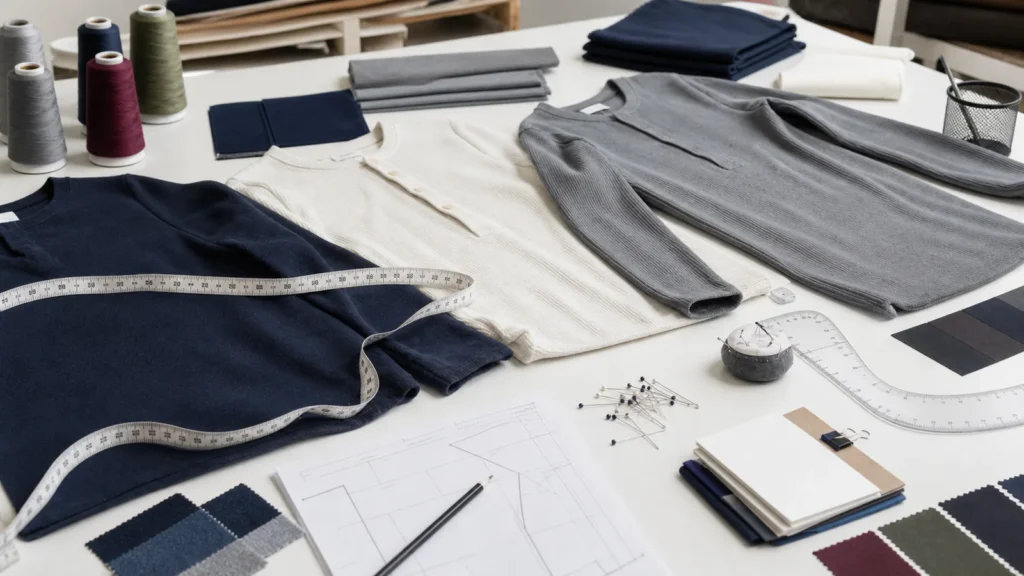
A fit sample focuses more specifically on garment measurements, proportions, movement, and comfort.
The sample is normally evaluated against a measurement specification and, where appropriate, on a suitable fit model or mannequin.
Instead of simply saying “the shirt is too tight,” buyers should provide measurable comments such as:
- Chest width needs adjustment
- Sleeve length is too long
- Shoulder width needs to increase
- Body length should be reduced
- Armhole needs modification
Specific comments make revisions easier to communicate.
3. Size Set: Does the Grading Work?
A garment may fit correctly in one size but still have problems across the full size range.
This is why a size set can be useful.
For example, a teamwear order may include:
XS, S, M, L, XL, 2XL and 3XL.
The purpose of reviewing multiple sizes is to determine whether the grading produces reasonable proportions across the range.
For buyers, this is especially important when:
- The order contains many sizes
- The garment has a fitted silhouette
- Sleeve or body proportions are important
- The product uses complicated panels
- The clothing is designed for athletic movement
4. Pre-Production Sample: What Should Bulk Production Follow?
The pre-production sample, often called a PP sample, has a different role.
It should represent the agreed production specification as closely as possible.
Depending on the project, this can include:
- Final fabric
- Final color
- Final trims
- Approved labels
- Final decoration
- Final construction
- Final finishing
The buyer can then approve this physical reference before bulk manufacturing.
Why Sample Approval Should Be Documented
A common problem in custom apparel projects is verbal approval.
For example:
“Looks good. Start production.”
This may not provide enough detail if a disagreement occurs later.
A stronger process is to record:
- Sample version
- Revision date
- Measurement comments
- Fabric information
- Color reference
- Artwork version
- Construction changes
- Approval status
The approved sample then becomes a physical reference for production and quality control.
A Practical Sampling Workflow
A typical development sequence can be:
Design → Proto → Fit Sample → Size Set → PP Sample → Bulk Production
Not every garment requires every stage.
A simple T-shirt may need fewer development rounds than a technical jacket or complicated team uniform.
The important principle is that each sample should have a defined purpose.
Questions Buyers Should Ask a Manufacturer
Before approving samples, buyers can ask:
- What does this sample confirm?
- Is the fabric final?
- Are the trims final?
- Has the pattern been updated?
- Which sizes have been checked?
- Are the measurements recorded?
- Will the approved sample be used as the bulk reference?
These questions can prevent a sample from being approved without knowing what exactly has been approved.
Our Approach to Custom Apparel
For custom clothing projects, we treat sample development as a controlled communication process between buyer and manufacturer.
The goal is not to produce as many samples as possible. Instead, each sample should answer a specific production question and provide information for the next stage.
For custom teamwear and uniforms, this approach can help connect design approval with the final manufacturing specification.
Conclusion
A sample is not simply a miniature version of the final order.
Different samples exist because different production risks need to be checked at different stages.
By understanding the difference between proto, fit, size-set, and pre-production samples, custom apparel buyers can make approvals more precise and reduce unnecessary revisions before bulk production.