

A sleeve vent is an opening near the lower end of a jacket sleeve. It allows the sleeve to open slightly, making it easier to adjust the cuff and creating a more refined tailored appearance.
Sleeve vents are commonly used in blazers, formal jackets, and structured outerwear. Depending on the design, they may be functional, decorative, or a combination of both.
For custom clothing suppliers, sleeve vent construction requires careful control of opening length, fabric overlap, button details, and internal finishing.
1. Choose Between Functional and Decorative Sleeve Vents
Sleeve vents generally fall into two categories.
A functional sleeve vent can open, allowing the cuff to be folded back or adjusted. It may include buttons and buttonholes.
A decorative or faux vent creates the appearance of an opening but remains permanently closed.
The choice depends on the jacket’s style, intended use, and construction complexity.
For formal tailoring, a functional vent can provide a more traditional finish. For simpler jackets, a decorative vent may be suitable when the main purpose is visual design.
Suppliers should ensure that the construction matches the intended function. A decorative vent should not be presented as a fully functional opening.
2. Determine the Correct Vent Length
Vent length affects both appearance and usability.
A very short vent may not provide enough opening for comfortable movement or cuff adjustment. An excessively long vent can make the sleeve look unbalanced and may expose too much of the inner construction.
The appropriate length depends on sleeve length, cuff design, jacket style, and the wearer’s proportions.
For custom jackets produced in multiple sizes, suppliers should check whether the vent remains visually balanced across the size range.
3. Plan the Overlapping Fabric Structure
A jacket sleeve vent usually requires overlapping fabric sections to create a clean opening.
The overlap should be planned before the sleeve is assembled.
The underlap and overlap need sufficient width to maintain coverage when the vent is closed. If the overlap is too narrow, the opening may reveal unfinished internal edges.
If it is too wide, unnecessary bulk may accumulate around the cuff.
The fabric should also be arranged so that the finished vent lies flat when closed.
4. Consider Button and Buttonhole Placement
Some functional sleeve vents include decorative or working buttons.
Their position should follow the direction of the vent and maintain consistent spacing.
If buttonholes are functional, they should be positioned so that the sleeve can open and close without excessive tension.
Buttons that are too close to the cuff edge may weaken the surrounding fabric. Buttons that are too far apart may look visually unbalanced.
The button size, thread, and reinforcement should be compatible with the jacket fabric.
5. Control Corner Construction and Seam Allowances
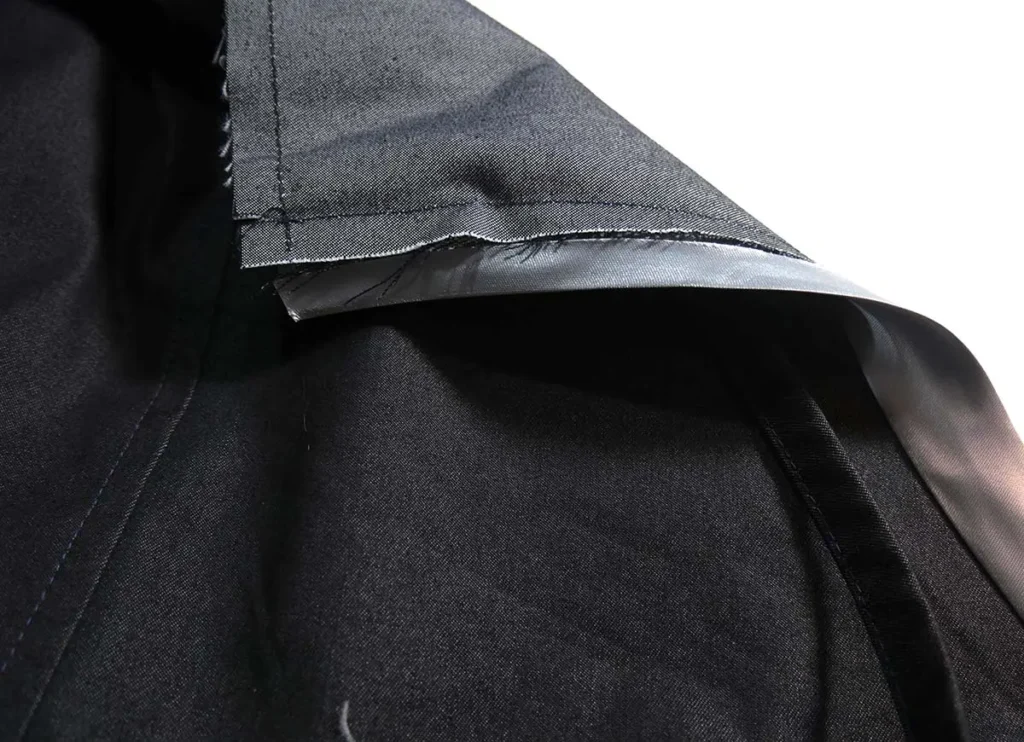
Sleeve vents often contain small corners and intersecting folded edges.
These areas require accurate stitching and careful trimming.
If seam allowances are not controlled, the vent may develop bulky corners or uneven edges.
The fabric should be trimmed only where necessary, leaving enough material to maintain secure construction.
At the vent corner, the stitching should meet the intended point accurately to prevent gaps or exposed raw edges.
6. Keep the Sleeve Lining Smooth
For lined jackets, the lining must be coordinated with the sleeve vent.
The lining should cover the appropriate internal edges without restricting the opening.
If the lining is too tight, it may pull against the vent when the wearer bends the arm. If it is too loose, excess fabric may become visible when the vent is opened.
Suppliers should check the relationship between the sleeve outer fabric and lining during assembly and fitting.
7. Inspect the Finished Sleeve Vent
A completed sleeve vent should be evaluated in both its closed and open positions.
Important inspection points include:
- Consistent vent length on both sleeves
- Smooth and even fabric overlap
- Clean internal edges
- Accurate button and buttonhole placement
- No puckering around the opening
- No excessive bulk at the corners
- Smooth lining movement
- Comfortable sleeve movement
For a functional vent, the buttons should be tested to ensure that the opening works as intended.
Conclusion
Sleeve vents are small details that can significantly influence the appearance of custom jackets. Accurate proportions, controlled overlap, clean corner construction, and proper lining coordination help suppliers achieve a more refined and functional sleeve finish.

