
Introduction
A pocket may look like a small detail on a garment, but it can have a significant effect on how the finished product performs.
For workwear, team uniforms, jackets, cargo pants, and outdoor apparel, pockets are often used repeatedly throughout the day. Workers may carry tools, phones, cards, keys, notebooks, or other equipment. Team members may use pockets while traveling, training, or working outdoors.
For custom apparel buyers, choosing a pocket should therefore involve more than deciding where it looks attractive. The pocket opening, pocket bag, attachment method, reinforcement, and position all need to match the intended use.
Start With What the Pocket Needs to Carry
The first question should be simple: What will the wearer actually put inside the pocket?
A pocket designed for a phone does not necessarily need the same construction as one designed for tools.
For lightweight items, a relatively simple pocket may be sufficient. For heavier objects, buyers should consider stronger attachment points and reinforcement around areas that receive repeated pulling.
For workwear, it can also be useful to separate storage functions. Instead of making one large pocket, a garment may use several smaller compartments for tools and personal items.
This can make the garment more practical without significantly changing its overall appearance.
Common Pocket Construction Options
Patch Pockets
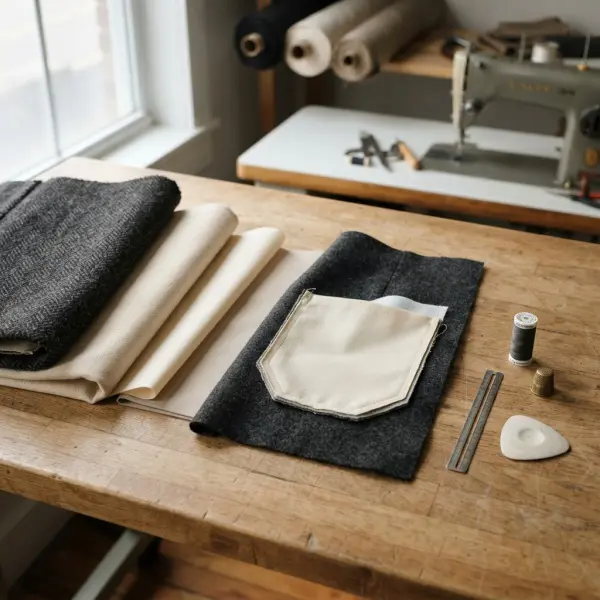
Patch pockets are attached directly to the outside of a garment.
They are commonly used on work shirts, jackets, uniforms, and casual garments. Because the pocket is visible, the stitching becomes part of the garment’s appearance.
For custom orders, buyers should specify:
- Pocket dimensions
- Position
- Shape
- Edge finishing
- Stitching details
- Reinforcement requirements
Patch pockets are relatively straightforward to communicate because their construction is visually easy to understand.
Welt Pockets
Welt pockets create a cleaner and more integrated appearance.
They are often used on trousers, jackets, and more structured garments. However, they generally require more precise construction than a simple patch pocket.
Buyers should pay particular attention to pocket opening dimensions and symmetry during sample approval.
Side-Seam Pockets
Side-seam pockets are integrated into the garment’s side seam.
They can provide a relatively clean appearance because the pocket opening does not necessarily add a large visible component to the garment exterior.
However, pocket placement needs to work with the garment’s fit and movement. A pocket that is technically correct but positioned too high or too low may be uncomfortable to use.
Cargo Pockets
Cargo pockets are designed for practical storage and are commonly associated with workwear and utility garments.
Their construction can include flaps, pleats, multiple compartments, or additional reinforcement.
The more complicated the pocket becomes, the more important it is to define its dimensions and construction clearly in the product specification.
Pocket Bag Material Matters
One mistake buyers sometimes make is focusing only on the visible outer pocket.
The pocket bag—the material forming the inside of the pocket—also matters.
A garment can have a strong outer fabric while using a pocket bag that is poorly suited to the intended application. Repeated friction, pulling, and contact with tools can eventually damage the pocket.
For this reason, buyers should consider:
- Pocket bag fabric
- Fabric weight
- Abrasion exposure
- Seam construction
- Seam allowance
- Reinforcement
- Expected load
The best material depends on the garment and application rather than simply choosing the strongest available fabric.
Reinforcement at Stress Points
Pocket openings and corners can experience concentrated stress.
For workwear or garments carrying heavier objects, reinforcement may be appropriate at selected points.
Possible approaches include additional stitching or bar-tack reinforcement. However, reinforcement should be used according to the actual stress pattern.
Too much reinforcement can add stiffness, bulk, and production complexity.
The goal is not to make every part of the pocket extremely heavy. The goal is to strengthen the areas that actually need additional support.
Pocket Position Affects Comfort
Pocket placement should also be evaluated on the wearer.
A pocket positioned too close to a seam may be difficult to access. A pocket placed in an area that bends frequently may create uncomfortable folds. A large pocket can also affect garment balance when filled.
For teamwear and workwear, buyers should test the garment while performing normal movements rather than evaluating the pocket only on a flat sample.
A practical sample test can include:
- Insert the intended items.
- Walk and sit while wearing the garment.
- Bend and reach.
- Remove items repeatedly.
- Check whether the pocket opening stays stable.
- Inspect the pocket after repeated use.
What Buyers Should Put in the Specification
A pocket should not simply be described as “one side pocket.”
A clearer specification can include:
- Pocket type
- Width and height
- Opening size
- Pocket position
- Pocket bag material
- Flap dimensions
- Closure method
- Stitching appearance
- Reinforcement points
- Color
- Symmetry requirements
A technical drawing or annotated sample can make these requirements easier for a manufacturer to understand.
Our Approach to Custom Apparel
When developing custom apparel, we treat pocket construction as part of the garment’s functional design rather than an isolated decorative detail.
Our approach is to review the intended use, pocket dimensions, materials, construction details, and reinforcement requirements before bulk production. Sample development allows the pocket position and usability to be checked before the final specification is confirmed.
For team uniforms, workwear, jackets, and utility garments, this process can help ensure that the final pocket design matches the way the garment will actually be used.
Conclusion
Pocket construction can influence durability, comfort, appearance, and production complexity.
For buyers ordering custom workwear or team apparel, the right approach is to start with the user’s needs and then select the appropriate pocket type, materials, dimensions, and reinforcement.
A well-designed pocket should not only look correct on a sample—it should remain practical when the garment is being used in real conditions.